Undergraduate Program
General information, curriculum, student outcomes, and annual student data for the Mechanical Engineering undergraduate program.
The undergraduate program in Mechanical Engineering at Bilkent University aims to provide students with strong scientific foundations, design skills, and practical engineering experience.
Undergraduate Program
The undergraduate program begins by introducing students to the fundamental elements of mechanical engineering, design and manufacturing processes, and the importance of computer skills in engineering through introductory courses in mechanical engineering and systems engineering.
In the second year of the program, mechanical engineering subjects are addressed through an integrated approach. Thermodynamics, fluid mechanics, and heat transfer are studied together, while mechanics and materials are also taught in a coordinated manner.
Curriculum
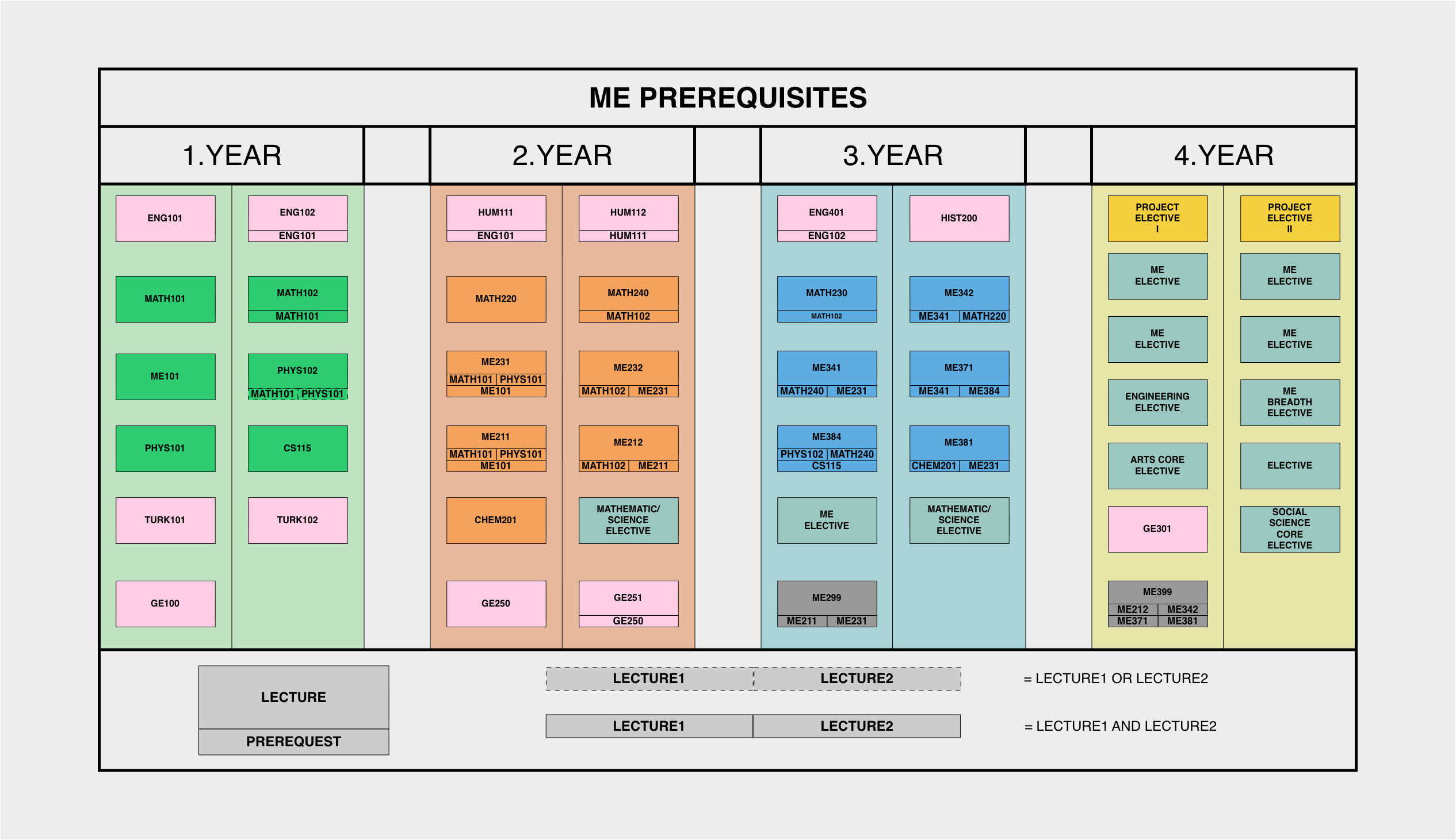
As a whole, the curriculum consists of integrated and advanced courses that build upon previous coursework. The educational program brings together laboratory, design, and computational activities in a coordinated manner.
In addition to the core mechanical engineering courses, other completed studies prepare students for senior-year design courses. This process is supported by modern laboratory facilities and hands-on project experience.
More InformationProgram Educational Objectives
The undergraduate program in Mechanical Engineering at Bilkent University aims to prepare students for their individual career paths and to develop their ability to adapt to the rapidly changing technologies encountered by engineers.
The program also aims to help students become innovative problem solvers and leaders in multidisciplinary environments through a flexible curriculum and interdisciplinary research opportunities.
Department Mission
The mission of the department is to provide students with a broad education in the scientific and applied foundations of engineering and to establish a strong foundation in problem solving, design, and communication skills.
The program aims to provide a rich environment for students’ learning and intellectual development, preparing them as lifelong learners and engineers capable of making responsible decisions in response to societal needs.
Student Outcomes
The Mechanical Engineering program has adopted the following ABET student outcomes:
| Outcome | Description |
|---|---|
| 1. | An ability to identify, formulate, and solve complex engineering problems by applying principles of engineering, science, and mathematics. |
| 2. | An ability to apply engineering design to produce solutions that meet specified needs with consideration of public health, safety, and welfare, as well as global, cultural, social, environmental, and economic factors. |
| 3. | An ability to communicate effectively with a range of audiences. |
| 4. | An ability to recognize ethical and professional responsibilities in engineering situations and make informed judgments that consider the impact of engineering solutions in global, economic, environmental, and societal contexts. |
| 5. | An ability to function effectively on a team whose members together provide leadership, create a collaborative and inclusive environment, establish goals, plan tasks, and meet objectives. |
| 6. | An ability to develop and conduct appropriate experimentation, analyze and interpret data, and use engineering judgment to draw conclusions. |
| 7. | An ability to acquire and apply new knowledge as needed, using appropriate learning strategies. |
Annual Student Enrollment and Graduation Data
| Academic Year | Preparatory Class | 1st Year | 2nd Year | 3rd Year | 4th Year | Total Undergraduate Students | Graduates |
|---|---|---|---|---|---|---|---|
| 2009-2010 | 49 | 39 | 79 | ||||
| 2010-2011 | 72 | 82 | 22 | 176 | |||
| 2011-2012 | 89 | 88 | 67 | 22 | 266 | ||
| 2012-2013 | 93 | 108 | 84 | 54 | 22 | 361 | 18 |
| 2013-2014 | 93 | 120 | 118 | 64 | 53 | 448 | 46 |
| 2014-2015 | 82 | 120 | 136 | 90 | 59 | 487 | 57 |
| 2015-2016 | 83 | 136 | 115 | 117 | 80 | 531 | 78 |
| 2016-2017 | 86 | 133 | 128 | 106 | 110 | 563 | 87 |
| 2017-2018 | 85 | 100 | 135 | 118 | 105 | 543 | 79 |
| 2018-2019 | 84 | 100 | 102 | 130 | 115 | 531 | 79 |
| 2019-2020 | 66 | 115 | 104 | 96 | 133 | 514 | 94 |
| 2020-2021 | 76 | 99 | 111 | 100 | 108 | 494 | 87 |
| 2021-2022 | 58 | 118 | 95 | 103 | 99 | 473 | 71 |
| 2022-2023 | 62 | 104 | 112 | 84 | 111 | 473 | 79 |
| 2023-2024 | 64 | 111 | 100 | 103 | 83 | 461 | 65 |
| 2024-2025 | 65 | 107 | 117 | 82 | 100 | 471 | 68 |
Prerequisite Table